Play Jigsaw Masterpieces: Ultimate Edition
Jigsaw Masterpieces: Ultimate Edition offers you a collage of casual jigsaw puzzle games that comes in all manner of themes including pets, the four seasons, food and beverages, cityline architecture, the great outdoors in general, and many more. There is no better place than here if you are looking to satisfy your need for jigsaw puzzles, and you can customize the difficulty based on your preference of how many pieces the total jigsaw puzzle should contain. So, whether it is diving into the ocean with marine life or exploring the animal kingdom in the wild, you can be sure that Jigsaw Masterpieces: Ultimate Edition has it all! Play Jigsaw Masterpieces: Ultimate Edition now for free as much as you want on a desktop PC or mobile device, even in fullscreen mode.
How to Play Jigsaw Masterpieces: Ultimate Edition
Jigsaw Masterpieces: Ultimate Edition is a classic jigsaw puzzle game where you construct the images back to its completion piece by piece. The origins of this puzzle game date back to the 18th century, when a picture was painted on a flat, rectangular piece of wood before being cut into small pieces. The goal in a jigsaw puzzle game is to reconstruct the complete image by piecing together the jigsaw pieces.
Jigsaw Masterpieces: Ultimate Edition Game Rules
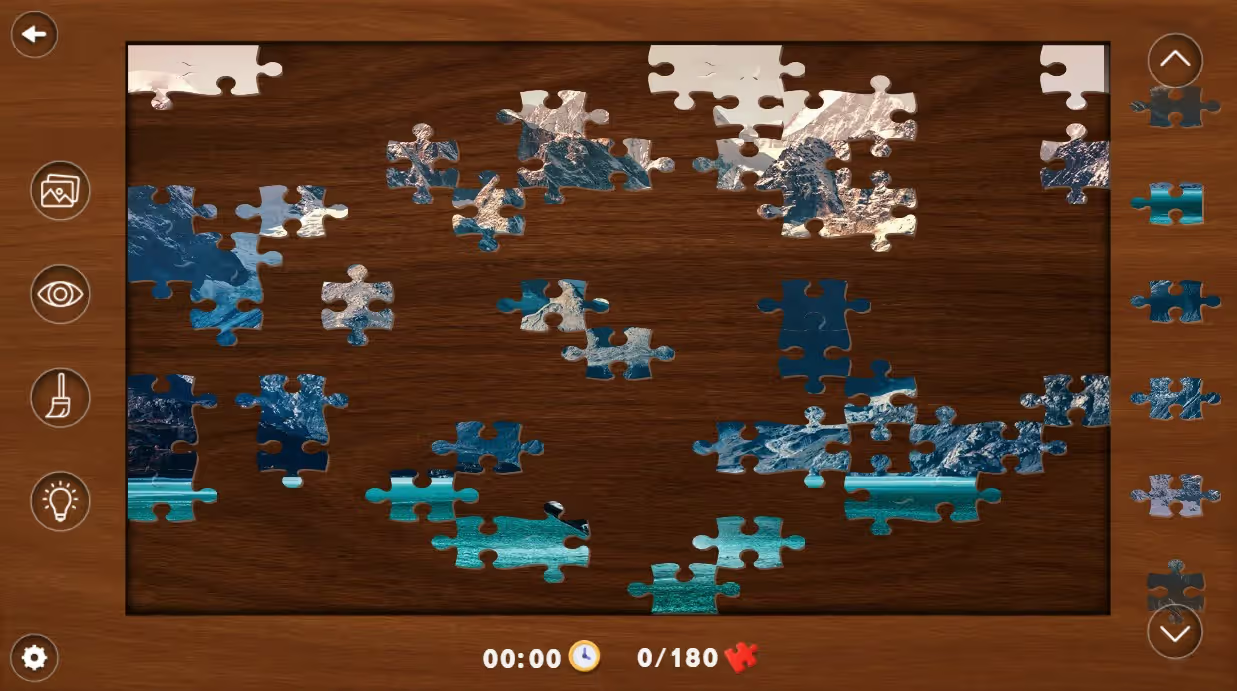
When a game of a jigsaw puzzle begins, you will see a complete image before it is disassembled into pieces, which are randomly set at the bottom of your screen. You can drag the pieces onto the board and begin constructing the image back, piece by piece.
You can choose how many total pieces to play with. The number of pieces corresponds with the difficulty of the puzzle. This usually can be 18, 54, 108, or 180 pieces.
To win a game of a jigsaw puzzle, players must figure out how to assemble the jigsaw pieces together to complete the image, the same as the one shown in the beginning. While some games may have a timer on top, it is merely for your own reference, as you can complete the jigsaw puzzle at your own pace.
Jigsaw Masterpieces: Ultimate Edition Tips and Tricks
- When a game starts, look for jigsaw pieces that have flat edges. These pieces are usually the border pieces, so it is really easy to know where they need to go on the board.
- Look for jigsaw pieces that stand out and segregate the similar-looking ones, especially pieces that can connect to form a large object in the image, into small piles on the board. These pieces usually go together, and you'll be able to connect them to form a section of the puzzle more easily.
- Don’t be afraid to designate a "dump" area on the board - usually one of the corners - just so you can drag and drop pieces that don't fit into any of your groups first. You can always move them later once you have found the right spot for them.
- If you feel that some pieces have colors that are too similar, pay attention to the shapes of the piece connectors, as that will also help you determine how the pieces fit together.
- If you need any help, there's no shame in using a hint or two. They are there for a reason, after all!
Jigsaw Masterpieces: Ultimate Edition FAQ
Is every game of Jigsaw Masterpieces: Ultimate Edition winnable?
Yes, every game is winnable. All you need is patience and the will to commit to the end. Knowing what to look for when trying to assemble the pieces also greatly helps you in completing the jigsaw puzzle more quickly.
When was the original jigsaw puzzle created?
It is believed that the very first jigsaw puzzle was created around 1760 by a man named John Spilbury. He was a London cartographer and engraver, and he glued a map to a flat piece of wood, which he then cut into pieces following the lines of the countries. This was initially used in teaching geography, but soon became a trendy pastime among adults as well, although it was more reserved for the wealthy at the time.
The modern portable jigsaw, which is more similar to the ones we have nowadays, was not introduced until 1947.
Does playing Jigsaw Masterpieces: Ultimate Edition benefit your brain?
Yes, playing jigsaw puzzle can benefit your brain in many ways. We have talked about some of the factors in our article, Piece Therapy: How Jigsaw Puzzles Help With Stress and Anxiety, which includes stress relief, focus training, and improving pattern recognition.
How is Jigsaw Puzzle different from Tetris?
The main difference between the two games is that jigsaw puzzles usually allow players to take their time putting the pieces together, whereas players of Tetris have to act fast to stack the pieces to complete lines. The playing field in a jigsaw puzzle is a constant, as you know the final image that you are working towards, but the playing field in Tetris is ever-changing, depending on the pieces that you get, and you’ll need to think on the fly about how to fit those pieces to create the lines needed to score.
Is there a difficulty curve in Jigsaw puzzle games?
Yes. Some jigsaw puzzle games have a time limit to see how quickly you can assemble the pieces compared to other players. There are even world competitions for this. Aside from that, there are some jigsaw puzzles that are just inherently more difficult due to their color theme, like an underwater-themed jigsaw puzzle where everything is mostly a gradient of blue. Finally, the main difficulty curve will be how many pieces the jigsaw puzzle you choose has, with more pieces corresponding to a higher difficulty.
Do jigsaw puzzles come in different themes?
Yes, they do! Some themes include beautiful scenery, portraits of famous people, food, underwater, holiday seasons, and more.
Are there any interesting trivia on jigsaw puzzles?
Well, fun fact: While John Spilbury used a marquetry saw for his work, the jigsaw was only invented in 1855, which is where the namesake of this puzzle game originates from. In fact, the term “jigsaw puzzle” didn’t appear until 1906.
Are there games that are similar in gameplay to jigsaw puzzles?
Yes, there are. The common ones are Tetris, Sudoku, and, surprisingly enough, hidden object games.
Tetris - The game mechanic of putting together pieces that fit to create complete lines feels very similar to how you find the right pieces to put together in a jigsaw puzzle.
Sudoku - You’re looking to put numbers in the right spot on a grid that fit properly as a whole in the “full picture”, similar to how you have to put the jigsaw pieces in the right spot to complete the image.
Hidden object games - This kind of game has you looking for objects that are hidden in the environment, similar to how you have to spot the things that stand out more on the jigsaw pieces to help you begin putting them together. Also, both types of games usually depict similar themes, like beautiful scenery or pictures of animals with a stunning backdrop.
Dive into a colorful world of puzzles inspired by art across every theme. Explore captivating collections featuring Animals, Food, Seasons, Architecture, and more. Choose your challenge from 18 to 180 pieces, and fall in love with jigsaw puzzles all over again!